The Day and Its Devotions
Dayton Daily Journal - May 31, 1869
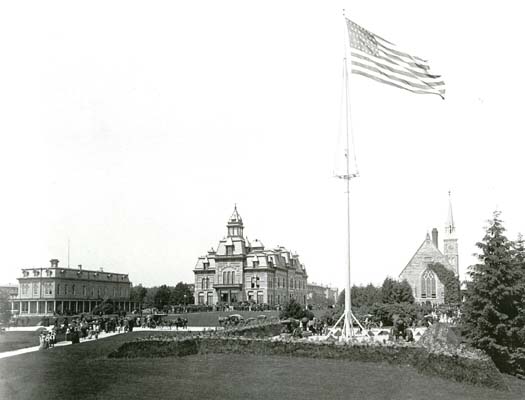
Background is a picture of the Grounds at the National Military Home
View the Background Picture
Article:
"In accordance with the custom inaugurated last year by a happy order from the Commander of the Grand Army of the Republic, Saturday was devoted to the ceremony of carrying a floral tribute to the graves of our fallen brave. As the only day of the year set apart to the memory of those who sacrificed their lives in subduing the Great Rebellion, it is a pleasant duty to Chronicle so general and imposing an observance as was witnessed in this city and at the National Asylum for disabled veterans near by. Everything passed off, as a general thing in a most fitting manner, most gratifying to the friends of those whose loss the whole community has mourned. Let us hope that the consecration of a day sacredly devoted to keeping alive in our hearts a love and gratitude for those who sacrificed their lives to preserve our liberty and National unity, may not only be generally observed but take a permanent place among the national festivals.
The crowd in attendance on Saturday was great, but not so large as that of last year; probably many from the surrounding country were deterred from participating b the threatening aspect of the weather. A dashing rain had fallen the previous night, soaking the ground, and making the woods now green with the beauties of the opening spring, wet and disagreeable. The day opened pleasantly, but threatening clouds made many fearful that the exercises of the day would be interrupted or prevented altogether.
First in order were the
EXERCISES AT THE SOLDERS' HOME
The 29th of May had been waited at the National Soldiers' Home with sad impatience. During the few weeks which preceded this memorial ceremony, an uncommon activity prevailed among all. The avenues and promenades were in fine order; the grass was carefully mowed; the barracks neatly painted and white-washed, as for an approaching festival. All about looked charming and full of brilliant hope. The protracted heat, and the stormy weather that followed on Thursday and Friday, cast a gloom over their fine expectations, and for a moment it was thought that the tribute to be paid to the memory of their fellow-soldiers would be done amidst showers, lightning and thunder. And so it truly looked. The previous rain had made a veritable slough of mud of many of the paths and alleys of the ground. On Saturday morning, however, though thick clouds filled the sky, announcing a new outbreak of the storm, the weather was pleasant, and the report of the cannon told that the hour for preparations had at last arrived. The procession was to be ready to march by ten o'clock. Before that hour it was interesting to observe the minute details of the preparation going on, which ordinarily precede such ceremonies. There was busy activity on every hand; the falling into line, companies forming, carriages arriving, and each faction of the assembly seeking its proper place.
The members of the G.A.R. had early assembled at their lodge where final arrangements were taken, such as delivering badges, crape, etc. They were clad in full uniform, wearing upon their breast the emblems of the organization; sad they were while mindful of the duties of the day. At 9 o'clock precisely they formed into a regular line, with an order and precision showing that they had not forgotten the stern discipline of former years. There were in the line, one-armed men, one-legged men; men on crutches, and men on artificial legs.
As they went through the military maneuvers, they were the objects of much attention from the assembled visitors. They were of that Grand Army who had organized this festival, and it was just that they should have the credit for it. Meanwhile, baskets full of the most magnificent flowers had been brought hither for general distribution. Those flowers weaved in garlands, wreaths, boquets and crosses, and were distributed by young misses and elderly matrons to the veterans, who received them with much grace, sensible, as they were, of the generous and loyal love with which they were donated.
At a few minutes before ten, the members of the G.A.R. each with a wreath or a boquet in hand, marched towards the Grand Avenue, before the headquarters, to assume their proper rank in the procession. The view at this place was very attractive. At the extremety of the barracks, towards the Amusement Hall, kept in trim order by our friend, Charles Naskaw, was formed in line a military company, composed of those inmates of the N.A., whose condition as to their physical disability, permitted the handling of firearms. Mr. Thoomy, an inmate popular among his fellows, had been the originator of this company. The artificial leg, which he wears with as much east as if he were not disabled, permits him to walk like any well bodied man, giving people occasion to inquire "What is the matter with him?" He walked with his band in the order of march, for he was to follow the Grand Marshall for the Day.
Finally the signal strikes. All are in a line. Major J. B. Thomas led the column as the grand officer of the ceremony, then a military escort of the G.A.R., the guests invited, the engine and hose company, and the inmates not belonging to the G.A.R. closed up the rear.
The Band belonging to the Home played a mournful requiem, as it led the procession, while the tap of the muffled drum filled the minds of the mourners with a deep melancholy.
In this order the procession proceeded toward the Asylum Cemetery. On the way thither is the hospital, a series of wooden buildings. During the formation of the procession a large number of young ladies kindly thinking of the sick, repaired to this spot to speak a few consoling words to those whose sufferings had been prolonged long after our fraternal struggle. At the battle of Hatcher's Run, in 1865, there was a young man, twenty years old, poor Harrington, who received a ball through the lower part of his body; the ball, by a downward course, made its escape through his leg, lacerating his frame and causing internal injuries, so severe as to make his case hopeless from the beginning. He lives yet, and in his couch is waiting the moment he will be relieved from his earthly sufferings. Your reporter has been acquainted with him for the last four years; and the courage and energy shown by young Harrington, during his illness, no tongue can tell; nor could nay language express the perpetual intensity of his sufferings. He, too, received a share of the bounty of the day. God bless the friends who remembered the shattered veteran in his affliction!
THE ASYLUM'S CEMETERY
Was reached at 10 1/2 o'clock. It was to be regretted, indeed, that the road which led to this sacred spot was rendered damp and miery by the rain.
The grave yard stands upon a sloping ground, shaded by loft oaks, beeches, and sundry other trees. At the foot of those old denizens of the forest lay the veteran sleeping in his silent grave. A green turf, carefully turned by a good-hearted brother, covers the mounds headed simply by a common painted pine board, upon which are written the name, company, and regiment of the dead. No pretentious marble marks their resting place. A fresh wind, which blows continually n the foliage, fills the soul with melancholy. It looks as if the whistlings above were the murmuring echos of those who slept in peace beneath. The graves are in three tiers. A side path well beat, gives easy access to every grave.
Here the procession halted. In front of the tombs, were displayed the military escort of Mr. Thoomy; then came in a central spot, the orators of the day, the Chaplain, the local manager, and officers of the Institution. The G.A.R., advanced in four columns, a member of the same standing at each grave with flowers in hand to deposit piously upon the sacred sod. The ladies with baskets full of garlands, crosses and wreaths formed a circle; visitors in carriages halted in the distance to gaze upon the solemn and touching scene. A pyramid of flower pots had been reared by the care of Mr. F. Mund, the gardner of the Institution. The taste displayed in this ornament, does credit to the author, as it honors the true sentiments of a comrade of the G.A.R. At the base of this pyramid, stood six little girls arrayed in white, with long golden hair, and holding in their hands the blessings of May. They were about of the same age and height, all blondes, and presented a beautiful appearance.
Silence soon followed and Chaplain P. M. Weddell, amidst the imposing scene, offered up an eloquent prayer to the throne of God."
The following information was taken out of context
by the transcriber because the speeches that were
provided in the original article are not duplicated here.